
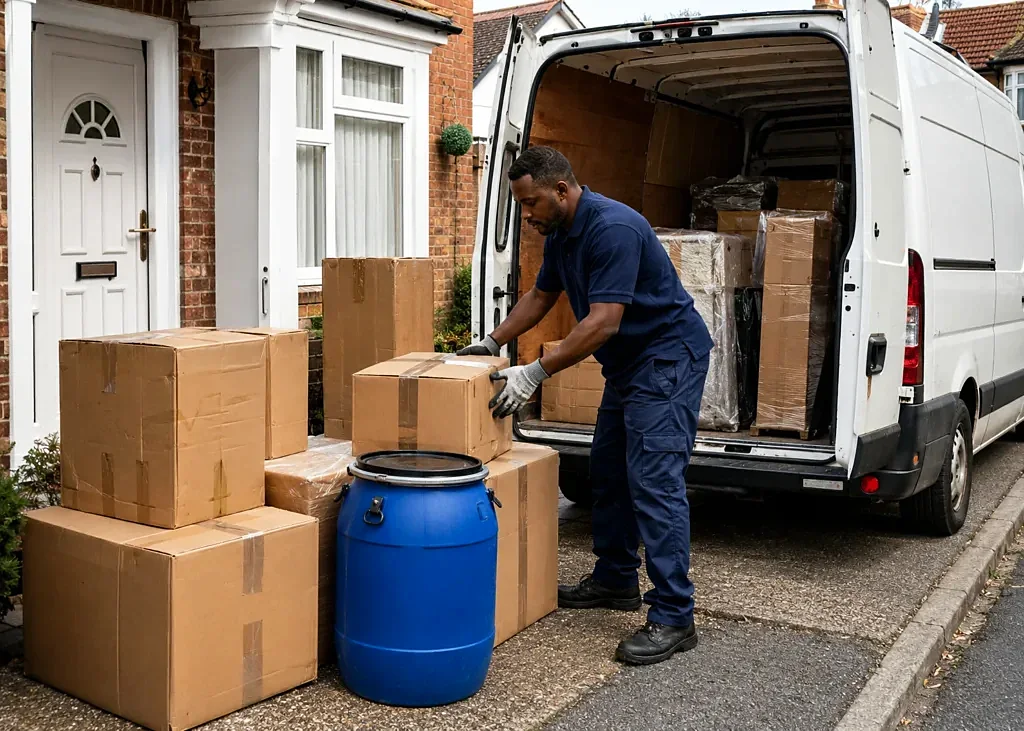
If you're sending things from the UK to Nigeria, the first thing to decide is whether it goes by air or by sea. Air gets there in days and makes sense for small, urgent or valuable items. Sea takes a few weeks, but it costs a lot less per kilo, so it's what most people use for barrels, heavy boxes, household goods and shop stock.
Below we go through how each one works, how the price is actually calculated, what you can and can't send, the paperwork, and what happens once your things land in Lagos. Whether you're sending a few boxes to family or buying stock in the UK for a business back home, it should answer most of your questions.
In this guide
Air or sea: the short version
| Option | Typical door-to-door time | Good for | Priced by |
|---|---|---|---|
| Air, express | 3 to 4 days | Documents, small urgent parcels, high-value items | Chargeable weight (kg) |
| Air, economy | 4 to 6 days | Parcels and cartons you need there within a week | Chargeable weight (kg) |
| Sea, shared container | 22 to 30 days | Barrels, heavy boxes, household goods, business stock | Volume (cubic feet or cubic metres) |
These are typical times from collection in the UK to delivery in Lagos, not promises. October to December is the busy season, and congestion at the Lagos ports can add a few days.
If it's heavy and it can wait, send it by sea.
How the price is worked out
It's tempting to compare quotes on the headline rate alone. What matters more is how that rate gets applied to your boxes, because air and sea measure them in different ways.
Air: you pay on chargeable weight
Airlines charge on whichever is higher: what your box actually weighs, or its volumetric weight. Volumetric weight is a measure of how much room the box takes up in the hold. For most air cargo it's worked out like this:
Length x width x height (in cm) / 6,000 = volumetric weight in kg
So a 60 x 50 x 40 cm box comes to 120,000, divided by 6,000, which is 20 kg. If the box only weighs 12 kg, you still pay for 20. If it weighs 25 kg, you pay for 25.
Some express couriers divide by 5,000 instead, which makes the same box count as heavier, so it's worth asking which figure a quote is based on. Anything light but bulky, like duvets, pillows, toys or clothes packed into big boxes, nearly always works out cheaper by sea.
Sea: you pay for space
When your goods share a container with other people's (the trade calls it LCL, less than container load), you pay for the space they take up, in cubic feet or cubic metres (CBM). One cubic metre is about 35.3 cubic feet. That same 60 x 50 x 40 cm box is 0.12 CBM, or roughly 4.2 cubic feet.
Because you're paying for space, packing well saves you money. Fill every box properly, use strong cartons of similar sizes, and don't pay to ship fresh air.
If you've got a lot to move, say a whole house or a big stock order, you can book a container to yourself (FCL, full container load), priced per container. A 20ft container holds about 33 cubic metres.
Other things that can go on the bill
- Collection from your address in the UK
- Packing materials or barrels, if you need them
- Customs duty and charges in Nigeria, mostly on commercial goods
- Delivery from Lagos to another state
- Storage, if nobody can take delivery on time
Ask for a quote that puts each of these on its own line. That's how we quote at Doubleway, so you can compare properly and nothing extra appears later.
What you can send from the UK to Nigeria
Most everyday shipments go through without any fuss: clothes and shoes for your own family, dry and sealed food, toiletries, kitchenware, small electronics, books, school things and presents. Businesses send retail stock, spare parts and equipment all the time.
Things that are banned or need a permit
Nigeria has an import prohibition list, and it changes now and then. These are the items that cause the most trouble:
- Used clothing in commercial quantities. Second-hand clothes are on the prohibition list, so bales or bulk lots will be seized. Clothes for your own family in normal amounts are fine, but list them clearly.
- Counterfeit goods of any kind.
- Medicines, supplements and cosmetics beyond personal use, which can need NAFDAC approval.
- Regulated products for sale, which may need SONCAP certification from the Standards Organisation of Nigeria.
- Dangerous goods such as anything flammable, aerosols and loose lithium batteries. There are strict rules on carrying these, especially by air.
- Fresh or perishable food.
- Cash, firearms and ammunition.
The easiest way to stay safe is to send us your list before you start packing. It only takes us a few minutes to check, and it could save you a seizure, a delay or storage charges at the port.
The paperwork
Sending to family
- A packing list for each box or barrel, with what's inside, how many and a rough value
- Your name, UK address and phone number
- The recipient's name, address in Nigeria and phone number
- A copy of photo ID, if we ask for it
Sending for a business
- A commercial invoice showing the goods, quantities and values
- A packing list with weights and dimensions
- An EORI number for the UK exporter, which businesses need to move goods out of Great Britain
- On the Nigerian side, a Form M opened by the importer through an authorised dealer bank before the goods ship. Nigeria Customs then processes the Pre-Arrival Assessment Report (PAAR) on its B'Odogwu system.
- Product permits where they apply, such as NAFDAC or SONCAP
If it's your first time bringing stock into Nigeria, our customs clearing team can talk you through Form M and PAAR before you place the order.
Once it lands in Nigeria
Air cargo comes into Murtala Muhammed International Airport in Lagos, and sea cargo arrives at the Lagos ports. Everything is declared to Nigeria Customs, any duty is assessed and paid, and then it's released for delivery.
Commercial goods pay import duty, levies and VAT, based on the HS code and the CIF value (cost, insurance and freight). Personal effects in normal amounts are treated differently, but a box full of the same new item can be counted as commercial. If you're honest and specific on your packing list, you'll avoid most surprises.
Our own team in Lagos handles the clearing and then delivers by road to any state in Nigeria.
Going the other way: Nigeria to the UK
We move goods from Nigeria to the UK too: fabrics, fashion, crafts, packaged goods and business samples. Food is where you need to be careful. The UK is strict about food imports, and meat and dairy from Nigeria aren't allowed in personal shipments. Business imports into the UK may also owe UK import VAT and duty. Have a word with us before you buy or pack anything, and see our UK and Nigeria shipping page for how it all works.
Shipping with Doubleway, step by step
- Send us your list. A WhatsApp message with what you're sending and roughly how big it is.
- Get a quote with every cost shown. Freight, collection, clearing and delivery, each listed separately.
- Drop it off or book a collection. Our van collects from anywhere in the UK.
- It goes by air or sea. We keep you updated on WhatsApp while it's on the way.
- Cleared and delivered. Our Lagos team clears it and delivers it to your family or business.
Questions people ask us
How long does shipping from the UK to Nigeria take?
Usually 3 to 4 days door to door by express air, 4 to 6 days by economy air, and 22 to 30 days by sea. The busy season and port congestion in Lagos can add time.
What's the cheapest way to ship from the UK to Nigeria?
Sea freight in a shared container, for anything heavy or bulky that isn't urgent. You pay for space, so packing tightly keeps the cost down.
Can I send a barrel to Nigeria?
Yes. A barrel is one of the most popular ways to send a mix of things home. Our guide to shipping a barrel to Nigeria from the UK covers what to pack and what to leave out.
Do you collect from anywhere in the UK?
Yes. We'll collect from any UK address, or you can drop off with us.
Will my family have to pay customs duty?
It depends on what's inside and how much of it. Commercial quantities pay duty. We look at your list before it ships and tell you what to expect.
Do you deliver outside Lagos?
Yes. Once it's cleared in Lagos, we deliver by road to any state in Nigeria.
Ready to send something home?
Send us a list of what you're shipping and we'll come back with a quote that shows every cost. Message us on WhatsApp or ask for a quote online.